One prefix, one root, one verb
A prefix verb is a verb built from two parts, a short prefix at the front and a root verb you already know. Aufstehen (to get up) is auf plus stehen (to stand). Anrufen (to call) is an plus rufen (to call out). German builds a large share of its everyday verbs this way, and the prefixes come in two kinds. Separable prefixes (trennbare Präfixe) break off and move to the end of the sentence. Inseparable prefixes (untrennbare Präfixe) stay glued to the verb, always. This page gives both systems and the two tests that tell them apart.
Jonas's morning in the book shows how much one pattern buys. He wakes up (aufwachen), gets up (aufstehen), opens the window (aufmachen), breathes in (einatmen), closes the window again (zumachen), turns the radio on (anmachen) and off again (ausmachen), gets dressed (sich anziehen), calls a colleague (anrufen), picks her up (abholen), sets off (losfahren), comes back in the evening (zurückkommen), and takes off his shoes (sich ausziehen). Thirteen verbs, only seven roots. Ten small prefixes do everything else.
Um halb sieben wacht Jonas auf. Er steht langsam auf, macht das Fenster auf und atmet tief ein.
At half past six Jonas wakes up. He gets up slowly, opens the window, and breathes in deeply.
The separable prefixes and what they mean
Each separable prefix keeps one core meaning from verb to verb, and the meaning is usually a place or a direction. Auf- is up or open, so aufstehen is to get up and aufmachen is to open. Aus- is out or off, so ausmachen is to turn off and sich ausziehen is to undress. Once the meaning of the prefix is in your head, a new verb built on a known root can often be guessed before it is looked up.
| Präfix | Core meaning | Example | English |
|---|---|---|---|
| an- | on, onto, at | anrufen | to call |
| auf- | up, open | aufstehen | to get up |
| aus- | out, off | ausmachen | to turn off |
| ein- | in, into | einatmen | to breathe in |
| zu- | closed, towards | zumachen | to close |
| ab- | away, off | abholen | to pick up |
| los- | off, away (start) | losfahren | to set off |
| mit- | along, with | mitkommen | to come along |
| zurück- | back | zurückkommen | to come back |
| weg- | away, gone | weggehen | to go away |
Every separable prefix can stand alone as a word (an, auf, aus, ein, mit, zu, zurück, weg). They are ordinary prepositions and adverbs doing a second job, which is why the sentence can pull them off again.
Where the prefix goes
In a normal main clause the prefix breaks off and moves to the very end of the sentence, while the root stays in second position and takes the personal ending. Ich rufe dich an (I call you) puts rufe second and an last. The book calls the verb a boomerang. You throw the prefix to the end, but it still belongs to the verb, and the sentence is not complete until it lands.
Two constructions show that the two parts are still one word. With zu plus infinitive, the zu goes between prefix and root, giving anzurufen. In the Perfekt, the past form used in speech, the ge- of the participle goes between them too, giving angerufen. A piece of grammar sitting inside the verb is the surest sign that prefix and root belong together.
| Context | German | English |
|---|---|---|
| Main clause | Ich rufe dich an. | I call you. |
| zu + infinitive | ..., um dich anzurufen. | ..., in order to call you. |
| Perfekt | Ich habe dich angerufen. | I called you. |
Ich hole dich um acht ab, dann fahren wir zusammen los.
I'll pick you up at eight, then we'll set off together.
Machst du das Licht an?
Will you turn on the light?
In a main clause the prefix goes to the end. With zu and with ge-, the extra piece goes between prefix and root (anzurufen, angerufen).
One root, one family
Take machen (to make, to do) and attach the prefixes from the table above. Every combination is a real, everyday verb, and the meaning of each is the meaning of the prefix applied to the root. You do not learn six new words. You learn one pattern and apply it six times.
| Verb | Meaning | Example | English |
|---|---|---|---|
| anmachen | to turn on | Machst du das Licht an? | Will you turn on the light? |
| ausmachen | to turn off | Mach den Fernseher aus! | Turn the TV off! |
| aufmachen | to open | Ich mache das Fenster auf. | I open the window. |
| zumachen | to close | Der Laden macht um acht zu. | The shop closes at eight. |
| mitmachen | to join in | Wir spielen. Machst du mit? | We're playing. Are you in? |
| weitermachen | to carry on | Kurze Pause, dann machen wir weiter. | Short break, then we carry on. |
The same machine runs on kommen (to come). Ankommen is to arrive, mitkommen is to come along, zurückkommen is to come back, and vorbeikommen is to drop by. Notice that the English in each case is also a verb plus a small word. English phrasal verbs (turn on, turn off, come along, drop by) are the same idea. English puts the particle after the verb, German glues it to the front and lets the sentence pull it off again.
Der Zug kommt um neun an.
The train arrives at nine.
Wann kommst du zurück?
When are you coming back?
The inseparable prefixes
Eight prefixes never separate, and the book has learners say them as a chant, be-, er-, ver-, ent-, zer-, ge-, emp-, miss-. Where a separable prefix names a place, an inseparable one carries a flavour, a looser tendency of meaning. Be- aims the verb at an object, so besuchen is to visit someone. Er- reaches a result, so erreichen is to reach. Ver- means change, away, or wrong, and is the busiest prefix in German. Some meanings must simply be learned as words, but the tendencies are real and worth knowing.
| Präfix | Flavour | Example | English |
|---|---|---|---|
| be- | aims at an object | besuchen | to visit |
| er- | achieves a result | erreichen | to reach |
| ver- | change, away, wrong | verlieren | to lose |
| ent- | away, un- | entdecken | to discover |
| zer- | to pieces | zerbrechen | to shatter |
| ge- | frozen history | gehören | to belong |
| emp- | (three verbs only) | empfehlen | to recommend |
| miss- | wrongly | missverstehen | to misunderstand |
Ver- earns its own set of examples, because its three flavours show up in different roots. Verkaufen (to sell) is giving something away for money. Verlieren (to lose) is something going away. Sich verlaufen (to get lost) is walking the wrong way. Verstehen (to understand) fits none of the three and has to be learned as a word. Paul's visit to his grandmother in the book runs on these prefixes. He visits her (besuchen), tells her about work (erzählen), never forgets her birthday (vergessen), discovers an old box with her in the cellar (entdecken), and promises to come every Sunday (versprechen).
Paul besucht seine Großmutter.
Paul visits his grandmother.
Ohne Karte verläuft er sich sofort.
Without a map he gets lost at once.
An inseparable prefix is never stressed and never leaves the verb. Say beSUchen, verSTEhen, entDEcken with the weight on the stem, and the prefix stays where it is.
Two tests that tell them apart
The first test is stress. Separable verbs stress the prefix, AUFstehen, ANrufen, EINkaufen. Inseparable verbs stress the stem, beSUchen, verSTEhen, entDEcken. Say a new verb out loud with the stress at the front, and if it sounds wrong, the prefix will not separate. The ear learns this rule before the head does.
The second test is the Perfekt, and it is the one to remember. A separable verb takes ge- between prefix and root, angerufen. An inseparable verb takes no ge- at all, because the prefix already fills that slot. Ich habe verstanden (I understood), ich habe bezahlt (I paid), ich habe vergessen (I forgot). Writing "gebezahlt" is the classic error, and this small table is the cure.
| Test | trennbar (separable) | untrennbar (inseparable) | English |
|---|---|---|---|
| Stress | ANrufen | verSTEhen | to call, to understand |
| Perfekt | hat angerufen | hat verstanden (no ge-) | called, understood |
One root can serve both families. Suchen (to search) gives besuchen (to visit), versuchen (to try), and untersuchen (to examine). And one false friend belongs on this page because it costs learners so often. Bekommen means to get, never to become, so ich bekomme einen Kaffee is I get a coffee. To become is werden.
Versuch es noch einmal!
Try it again!
Inseparable verbs never take ge- in the Perfekt. Hat bezahlt, hat verstanden, hat entdeckt. If the prefix is unstressed, there is no ge- and no separation.
Where this comes from
This page condenses chapters 2 and 3 of Der Wortbaukasten, "Trennbare Verben: das Muster" and "Untrennbare Verben", the opening chapters of the part called The Building Blocks. Chapter 2 opens with Jonas's morning and chapter 3 with Paul's visit to his grandmother, each a full scene in German with its English translation, and every verb in the tables on this page comes from those two chapters.
The chapters add what a page cannot hold. Each carries a word field of two to three dozen verbs with their principal parts (aufstehen, stand auf, ist aufgestanden), sorted into groups such as morning and evening, on and off, be- aiming at things and er- reaching results. Each has a recognition list of further verbs (aussteigen, umsteigen, stattfinden, bestehen, gewinnen) and five exercises, from matching prefixes to meanings and splitting verbs correctly inside a sentence to putting five sentences into the Perfekt and writing a short apology note with sich entschuldigen, vergessen and versprechen. A free sample chapter of Der Wortbaukasten can be read on the book page.
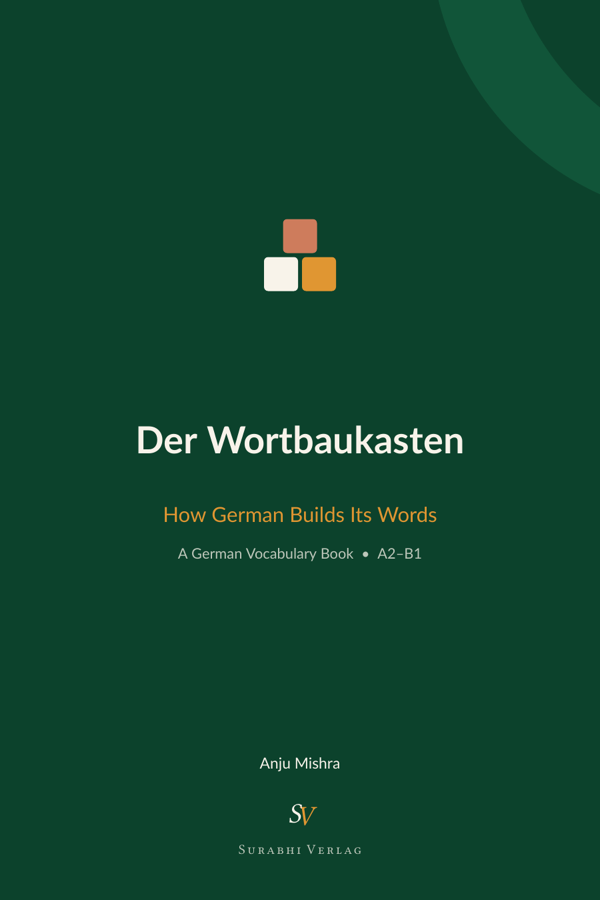
Der Wortbaukasten
How German builds its words. Roots, prefixes and suffixes first, then twenty everyday vocabulary fields.
Continue with
- Der, die or das? The endings that decide German gender
- weil, denn, deshalb: German connectors and where the verb goes
Five German patterns by email
A free short course. One pattern every few days, German and English side by side, from these books. Unsubscribe with one click.
Double opt-in, no tracking. Details in the Datenschutz.