Teil 1 of the Goethe-Zertifikat B1 writing paper asks for an informal email to a friend of about 80 words, with roughly 20 minutes planned for it. Three content points are printed with the task, and the markers check first of all whether every point is genuinely covered. The email below answers one such task completely, and the sections that follow take it apart one sentence at a time, naming which part of the letter each sentence fills and what it earns.
The task
A task in this part always has two layers. First comes a short situation in two sentences, then three points that the email must contain. The situation is never to be retold, because the reader already knows it. The three points are the checklist the marker holds while reading.
Ihre Freundin Carla hat Sie eingeladen, am Wochenende mit ihr wandern zu gehen. Schreiben Sie eine E-Mail an Carla (circa 80 Wörter).
Your friend Carla has invited you to go hiking with her at the weekend. Write an email to Carla (about 80 words).
- Sagen Sie: Sie kommen gern mit. (Say that you are happy to come along.)
- Machen Sie einen Vorschlag: Was nehmen Sie beide mit? (Make a suggestion about what the two of you will take.)
- Fragen Sie: Wie fahren Sie dorthin? (Ask how you will get there.)
Since the task names Ihre Freundin Carla (your friend Carla), the register is du, written lowercase throughout, with a warm greeting and a friendly sign-off. Being a few words over or under the 80-word guideline does no harm, but a missing content point costs heavily, so the safest layout gives each point its own short paragraph.
Give each of the three content points its own short paragraph. A missing point costs heavily, a few words over or under the guideline cost nothing.
The email, sentence by sentence
The model answer follows the five-part skeleton of every German letter, that is, Anrede (greeting), Einleitung (opening line), Hauptteil (body), and Gruß und Name (sign-off and name), with no Betreff because the task supplies none. The greeting comes first, and it already shows two rules. Liebe takes the ending -e because Carla is a woman, and the line ends in a comma, so the next line continues the sentence and starts lowercase.
Liebe Carla,
Dear Carla,
The first paragraph is the Einleitung and content point 1 in one. It opens with the standard thanks for the invitation, then gives the acceptance and a reason for it in a single sentence, joined with denn (because). After denn the word order does not change at all, so ich war stays exactly as it would in a main clause.
vielen Dank für deine Einladung zum Wandern! Ich komme sehr gern mit, denn ich war schon lange nicht mehr in den Bergen.
thank you very much for the invitation to go hiking! I am very happy to come along, because I have not been to the mountains for a long time.
The second paragraph is content point 2, the suggestion. It uses the fixed phrase Ich schlage vor, dass (I suggest that), which sends the verb mitbringe to the end of its clause. The next sentence adds a second item with außerdem (in addition), which takes position 1 and pushes the verb packe into position 2, and it justifies the item with weil (because), which sends the verb ist to the end. The paragraph closes with a polite request in Könntest du (could you), so the suggestion involves Carla too.
Ich schlage vor, dass ich Brote und Obst für uns mitbringe. Außerdem packe ich eine Regenjacke ein, weil das Wetter am Wochenende unsicher ist. Könntest du vielleicht das Wasser für uns beide übernehmen?
I suggest that I bring sandwiches and fruit for us. I will also pack a rain jacket, because the weather at the weekend is uncertain. Could you perhaps take care of the water for us both?
The third paragraph is content point 3, the question. Eine Frage habe ich noch (I have one more question) announces it, and the question itself is an either-or question, train or car, which makes it easy for Carla to answer. The last sentence asks for a reply and gives a purpose with damit (so that), another clause with the verb at the end, so the email ends with a clear goal rather than trailing off.
Eine Frage habe ich noch: Wie kommen wir am besten hin? Sollen wir mit dem Zug fahren, oder holst du mich mit dem Auto ab? Sag mir bitte kurz Bescheid, damit ich planen kann.
I have one more question: how do we best get there? Shall we take the train, or will you pick me up by car? Please let me know briefly so that I can plan.
The closing line and the sign-off finish the skeleton. Bis Samstag (see you Saturday) looks ahead to the meeting, Liebe Grüße is the informal Gruß that matches Liebe Carla, and it takes no comma or full stop before the name on the next line.
Bis Samstag, ich freue mich schon! Liebe Grüße Nina
See you Saturday, I am already looking forward to it! Love, Nina
React to the situation, do not retell it. Carla knows she invited you. She wants your answer, your suggestion and your question.
The plain version and what the connected one adds
The same task can be answered correctly at A2 level, and the book prints that version too, so that the difference is visible. Both versions cover all three points, both are the right length, and both use du correctly. What separates them is connection, and connected text is rewarded in this exam.
Liebe Carla, vielen Dank für deine Einladung. Ich komme gern mit! Wandern macht mir viel Spaß. Ich habe eine Idee: Ich bringe Brote und Obst für uns mit. Kannst du eine Flasche Wasser mitnehmen? Vielleicht brauchen wir auch eine Regenjacke. Ich packe auch etwas Schokolade ein.
Dear Carla, thank you very much for your invitation. I am happy to come along! Hiking is great fun for me. I have an idea: I will bring sandwiches and fruit for us. Can you take a bottle of water? Perhaps we also need a rain jacket. I will also pack some chocolate.
Eine Frage habe ich noch: Wie kommen wir zum Berg? Fahren wir mit dem Zug oder mit dem Auto? Bis Samstag! Ich freue mich. Liebe Grüße Nina
I have one more question: how do we get to the mountain? Are we going by train or by car? See you on Saturday! I am looking forward to it. Love, Nina
Four changes turn this plain version into the connected one above. The connected version links acceptance and reason with denn in one sentence, instead of adding the reason as a separate short sentence. It makes a real suggestion with Ich schlage vor, dass and justifies the rain jacket with weil. It asks an either-or question, train or car, rather than an open one. And it asks for a reply with damit ich planen kann, which gives the whole email a purpose. The table lists the four connectors the model uses and where each one puts the verb.
| Wort | Verb position | In the model | English |
|---|---|---|---|
| denn | unchanged, verb stays in position 2 | Ich komme sehr gern mit, denn ich war schon lange nicht mehr in den Bergen. | I am very happy to come along, because I have not been to the mountains for a long time. |
| außerdem | position 1, verb follows in position 2 | Außerdem packe ich eine Regenjacke ein. | I will also pack a rain jacket. |
| weil | verb at the end of the clause | weil das Wetter am Wochenende unsicher ist | because the weather at the weekend is uncertain |
| damit | verb at the end of the clause | damit ich planen kann | so that I can plan |
Three or four connectors per email are enough. denn and außerdem leave the verb in position 2, weil and damit send it to the end.
Redemittel to take into the exam
Five phrases from the model can be reused in any invitation email, whatever the friend is inviting you to. Each one fills a slot of the skeleton, so learn them by the job they do rather than as a bare list.
| Redemittel | Job in the email | English |
|---|---|---|
| Vielen Dank für deine Einladung! | Einleitung, thanks | Thank you very much for your invitation! |
| Ich komme sehr gern mit. | point 1, acceptance | I am very happy to come along. |
| Ich schlage vor, dass ... | point 2, suggestion | I suggest that ... |
| Soll ich ... mitbringen? | point 2, offer | Shall I bring ...? |
| Sag mir bitte kurz Bescheid. | Schluss, request for a reply | Please let me know briefly. |
A second task and its model answer
The book closes the unit with a task of the same shape for you to write yourself, and the model solution is printed at the back. Try it before reading the answer, then compare point by point. The three content points here are acceptance, a question about when and where to meet, and a suggestion for afterwards.
Ihr Freund Timo hat Sie zu einem Konzert am Freitag eingeladen. Schreiben Sie ihm eine E-Mail (circa 80 Wörter): Sagen Sie zu, fragen Sie, wann und wo Sie sich treffen, und schlagen Sie vor, was Sie nach dem Konzert zusammen machen können.
Your friend Timo has invited you to a concert on Friday. Write him an email (about 80 words): accept, ask when and where you will meet, and suggest what you can do together after the concert.
Lieber Timo, vielen Dank für deine Einladung, ich komme sehr gern mit! Auf das Konzert freue ich mich schon lange, denn ich liebe diese Band. Wann und wo treffen wir uns am Freitag? Ich könnte schon um 18 Uhr da sein, damit wir gute Plätze bekommen. Außerdem habe ich eine Idee: Nach dem Konzert könnten wir noch eine Pizza essen gehen, weil das kleine Restaurant neben der Halle bis Mitternacht offen hat. Sag mir bitte kurz Bescheid! Liebe Grüße Jana
Dear Timo, thank you very much for your invitation, I am very happy to come along! I have been looking forward to the concert for a long time, because I love this band. When and where shall we meet on Friday? I could be there as early as six o'clock, so that we get good seats. I also have an idea: after the concert we could go for a pizza, because the small restaurant next to the hall is open until midnight. Please let me know briefly! Love, Jana
Notice that the same four connectors return in the same roles, denn for the reason behind the acceptance, damit for the purpose of arriving early, außerdem to add the suggestion, weil to justify it. The greeting changed to Lieber because Timo is a man, and the sign-off stayed Liebe Grüße. Everything else is the skeleton, filled in for a new situation.
Where this comes from
This page condenses Unit 12 of The Art of Writing, Goethe B1, Teil 1: die E-Mail, in the Prüfung section of the book, together with the Timo model answer from the solutions at the back. The unit prints the exam strategy, Version A and Version B side by side with their English translations, the list of differences, the Redemittel and the writing assignment. The five-part skeleton it relies on is the subject of the book's first chapter, Der Bauplan, which is summarised on German B1 letter writing: the blueprint and the Redemittel.
The other exam units of the book treat the remaining letter types in the same way, and the connectors used here are explained with their verb positions on weil, denn, deshalb: German connectors and where the verb goes. A free sample of the book is available on the book page.
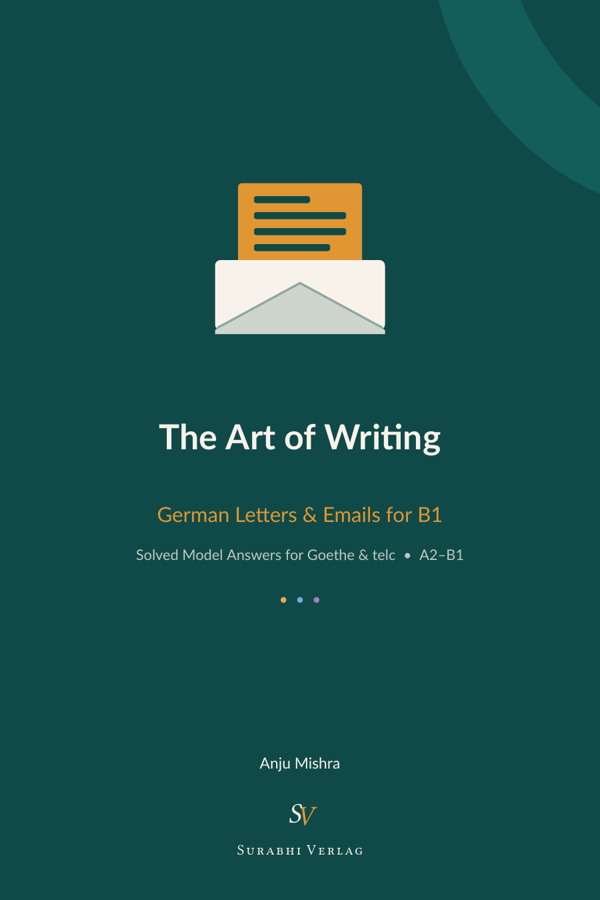
The Art of Writing
Every letter type of the B1 exam, each with its Redemittel, a model letter and an exercise with solution.
Continue with
- German B1 letter writing: the blueprint and the Redemittel
- weil, denn, deshalb: German connectors and where the verb goes
Five German patterns by email
A free short course. One pattern every few days, German and English side by side, from these books. Unsubscribe with one click.
Double opt-in, no tracking. Details in the Datenschutz.