Gender lives in the ending
The gender of a German noun is the article it takes, der, die or das, and the noun carries that article as part of itself. Most learners treat the choice as luck, something to be memorised one word at a time. It is not luck. The end of the noun decides its gender far more often than chance, and a handful of endings cover most of the nouns an A2 or B1 learner meets. Read the ending, not the thing the word names, and the article follows.
Take one morning. Nora lives in a small flat (die Wohnung, die Wohnungen) above a bakery (die Bäckerei, die Bäckereien). She buys a roll (das Brötchen, die Brötchen) from the baker (der Bäcker, die Bäcker) and reads the newspaper (die Zeitung, die Zeitungen). Five nouns, three genders, and not one of them has to be learned on its own. Wohnung and Zeitung end in -ung, so they are die. Bäckerei ends in -ei, so it is die. Brötchen ends in -chen, so it is das. Bäcker names a person who does something, so it is der.
Nora wohnt in einer kleinen Wohnung über einer Bäckerei.
Nora lives in a small flat above a bakery.
Jeden Morgen kauft sie beim Bäcker ein warmes Brötchen und liest die Zeitung.
Every morning she buys a warm roll at the baker's and reads the newspaper.
The article is not decoration. Never learn "Zeitung", learn "die Zeitung", because the ending -ung has already chosen the article for you.
The nine endings
An ending here means a suffix, a fixed tail attached to a stem, and the same suffix always brings the same article. The table lists the nine the book relies on. Five give die, two give das, two give der, and the examples are the words from Nora's morning together with a few from the chapter's word list.
| Ending | Article | Examples | English |
|---|---|---|---|
| -ung | die | die Wohnung, die Zeitung | flat, newspaper |
| -heit, -keit | die | die Gesundheit, die Möglichkeit | health, possibility |
| -schaft | die | die Freundschaft, die Mannschaft | friendship, team |
| -ion, -tät | die | die Information, die Universität | information, university |
| -ei | die | die Bäckerei, die Polizei | bakery, police |
| -chen, -lein | das | das Brötchen, das Mädchen | bread roll, girl |
| -um, -ment | das | das Museum, das Dokument | museum, document |
| -er (a doer) | der | der Bäcker, der Fahrer | baker, driver |
| -ling | der | der Frühling, der Lehrling | spring, apprentice |
Now read the second half of Nora's morning with the table in view. The newspaper says the university is looking for people to take part in a study on friendship and health, and Nora sees an opportunity. Universität ends in -tät, Untersuchung in -ung, Freundschaft in -schaft, Gesundheit in -heit, and Möglichkeit (die Möglichkeit, die Möglichkeiten, possibility) in -keit. Five nouns, and every one of them is die.
Die Universität sucht Leute für eine Untersuchung über Freundschaft und Gesundheit.
The university is looking for people for a study on friendship and health.
The words below are the ones the chapter asks you to own, each with its plural. The plural matters because it is the third part of the word, after article and stem, and the book's rule is to learn all three together. Where a noun has no plural in ordinary use, the table says so.
| Noun | Plural | English |
|---|---|---|
| die Wohnung | die Wohnungen | flat, apartment |
| die Übung | die Übungen | exercise |
| die Meinung | die Meinungen | opinion |
| die Erfahrung | die Erfahrungen | experience |
| die Gesundheit | no plural | health |
| die Krankheit | die Krankheiten | illness |
| die Schwierigkeit | die Schwierigkeiten | difficulty |
| die Mannschaft | die Mannschaften | team |
| die Information | die Informationen | information |
| die Universität | die Universitäten | university |
| das Brötchen | die Brötchen | bread roll |
| das Museum | die Museen | museum |
| das Zentrum | die Zentren | centre |
| das Dokument | die Dokumente | document |
| der Fahrer | die Fahrer | driver |
| der Lehrling | die Lehrlinge | apprentice |
The same suffix always brings the same article. -ung, -heit, -keit, -schaft, -ion, -tät and -ei are die. -chen, -lein, -um and -ment are das. A doer in -er and any word in -ling is der.
The -chen machine
The ending -chen is more than a label to recognise. It is a tool you can use. Attach -chen to any noun and you get its small version, a diminutive. The vowel of the stem often takes an umlaut, so a becomes ä and u becomes ü, and the gender of the new word is always das, whatever the gender of the old one was. Das Haus (the house) becomes das Häuschen (the little house). Der Hund (the dog) becomes das Hündchen (the little dog), and the der is gone.
| Base noun | Small form | English |
|---|---|---|
| das Haus | das Häuschen | the house, the little house |
| der Hund | das Hündchen | the dog, the little dog |
| die Magd | das Mädchen | the maid, the girl |
Am See steht ein rotes Häuschen.
By the lake stands a little red house.
Das Hündchen schläft im Korb.
The puppy is sleeping in the basket.
The third row settles a puzzle that troubles every beginner. Why is it das Mädchen and not die Mädchen, when a girl is plainly female? Because Mädchen is built from die Magd (the maid) plus -chen, and -chen always wins, even against natural gender. The same machine turns das Brot (the bread) into das Brötchen (the bread roll) that Nora buys, and it is why the girl from the house next door, at the end of Nora's morning, is das.
Das Mädchen winkt.
The girl waves.
-chen always makes a noun das, even when the thing it names has a natural gender. Das Mädchen is neuter because the ending outranks the meaning.
Three meaning groups for der
Endings do most of the work, but three groups of meaning add to the coverage, and all three point to der. Days of the week, months, and seasons are masculine. That gives der Montag (Monday), der Januar (January), and der Frühling (spring), and with it der Sommer, der Herbst and der Winter (summer, autumn, winter). Weather is masculine too, at least the wet and windy kind. Der Regen (rain), der Schnee (snow), and der Wind (wind) all take der.
Treat the weather group as a tendency rather than a law. Die Sonne (the sun), die Wolke (the cloud), and das Gewitter (the thunderstorm) go their own way, and the book says so plainly. The last sentence of Nora's morning holds one of each kind. The sun is die because it is one of the exceptions, and spring is der twice over, because seasons are der and because -ling is der, two rules agreeing on one word.
Die Sonne scheint, und am Ende der Straße wartet schon der Frühling.
The sun is shining, and at the end of the street, spring is already waiting.
Days, months, seasons and most weather are der. Die Sonne and das Gewitter show that the weather rule is a tendency, so check a weather word before you trust it.
Two things to watch
The first is the ending -er. It means der only when the word names a doer, someone or something that performs the action in the stem. Der Fahrer (the driver) drives, der Bäcker (the baker) bakes, der Schüler (the pupil) studies. Things that merely happen to end in -er follow no such rule. Das Fenster (the window) is neuter and die Butter (the butter) is feminine. When a noun in -er is not a person doing something, look it up rather than guess.
The second is the plural, and it is good news. In the plural, gender disappears. Nominative and accusative both take die for every noun, so die Brötchen (the rolls), die Männer (the men), and die Zeitungen (the newspapers) all carry the same article, whatever they took in the singular. Only the dative changes the plural article, to den, and the genitive der can wait until B1. So the rules on this page are rules for the singular, which is where the article is actually a choice.
Learn every noun as article, word and plural in one breath, "die Zeitung, die Zeitungen". In the plural the article is die for every noun, so gender is a question about the singular.
Where this comes from
This page condenses chapter 5 of Der Wortbaukasten, "Das Genus", in the part of the book called The Building Blocks. The chapter opens with Nora's morning as a full scene in German with an English translation, and every highlighted noun in that scene is one the ending table explains.
The full chapter adds what a page cannot hold. It carries a word list of 27 nouns sorted by article, each with plural and level, a recognition list of further words that follow the same endings (die Regierung, die Wissenschaft, das Instrument, der Schüler), and five exercises, from sorting eight nouns into der, die and das and building diminutives with -chen to explaining in your own words why das Mädchen is neuter. A free sample chapter of Der Wortbaukasten can be read on the book page.
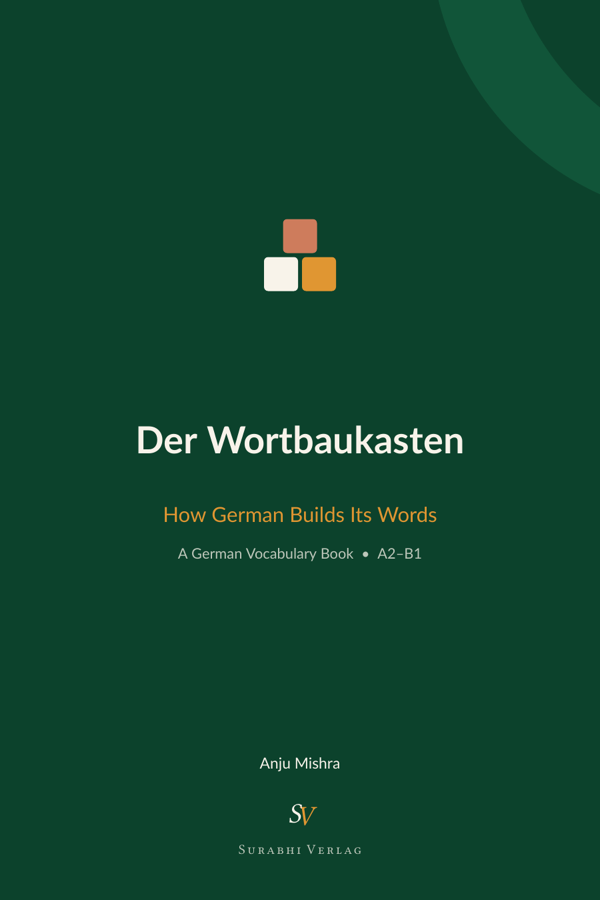
Der Wortbaukasten
How German builds its words. Roots, prefixes and suffixes first, then twenty everyday vocabulary fields.
Continue with
Five German patterns by email
A free short course. One pattern every few days, German and English side by side, from these books. Unsubscribe with one click.
Double opt-in, no tracking. Details in the Datenschutz.